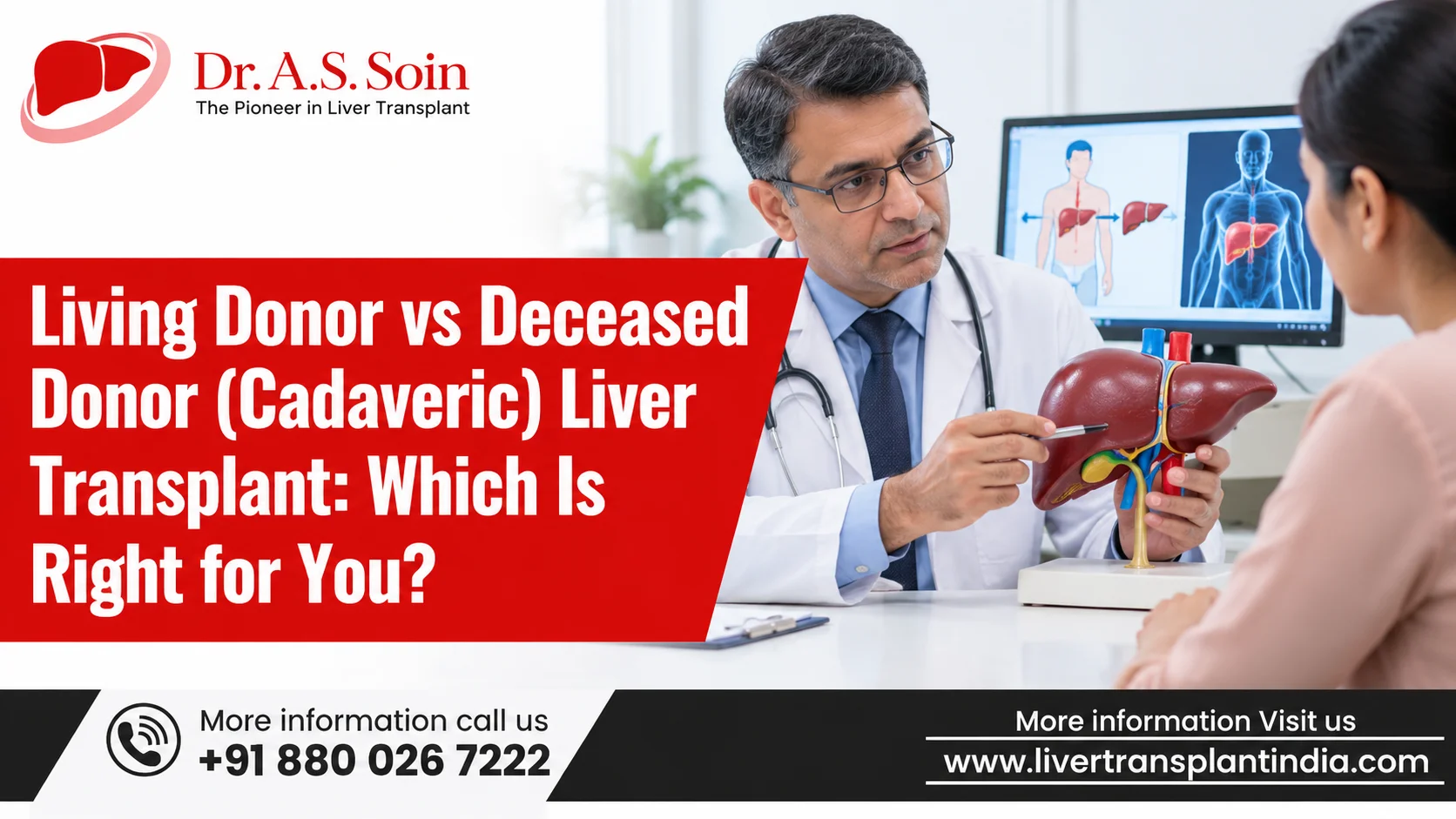
When you or a loved one needs a liver transplant, one of the first questions the transplant team will address is the availability of a donor liver. Patients searching for the best liver transplant doctor in Delhi are typically guided through two main pathways: a living donor or a deceased donor. With a living-donor transplant, a healthy person donates a portion of their liver, which regenerates to full functional capacity over time. In a deceased-donor transplant, the patient receives a whole (or split) liver from a person who has been declared brain-stem dead and whose family has consented to organ donation. This guide explains both options in clear terms, compares their key differences, and outlines how transplant specialists determine which approach best fits each patient.
Quick Answer: Living Donor or Deceased Donor?
A living-donor liver transplant involves removing a portion of the liver from a healthy, medically suitable donor and transplanting it into the patient. Because the procedure is scheduled in advance, it reduces waiting time and allows surgery before the patient’s health deteriorates further. A deceased-donor (cadaveric) liver transplant uses an organ donated after brain death and depends on organ availability through the official waiting list. Neither approach is universally superior. The safest choice depends on the patient’s clinical urgency, the availability of a fit family donor, blood group and liver volume compatibility, and the transplant team’s overall assessment.
What Is a Living Donor Liver Transplant?
A living-donor liver transplant (LDLT) is a procedure in which a healthy adult donates a portion of their liver to a patient with end-stage liver disease or liver cancer. The liver is unique because it can regenerate. After surgery, the transplanted segment grows inside the recipient, and the donor’s remaining liver also regrows to nearly its original volume and full function within 6 to 8 weeks. For an adult recipient, surgeons usually remove the larger right lobe (about 60% to 65% of the liver). For a child, a smaller left lateral segment (about 20%) from a parent or relative is typically sufficient. The donor must be a healthy adult (usually aged 18 to 55) with a compatible blood group, adequate liver volume, no fatty liver disease, and no major medical conditions. Every prospective donor undergoes a rigorous, multi-stage evaluation to ensure their safety comes first.
What Is a Deceased Donor (Cadaveric) Liver Transplant?
A deceased-donor liver transplant (DDLT) uses an organ donated by an individual declared brain-stem dead, following formal consent from the donor’s family. Once recovered, the liver is allocated to a registered patient on the transplant waiting list. In select cases, surgeons perform a “split-liver” transplant, dividing a single deceased donor liver between two recipients—typically an adult and a child. Because deceased donation cannot be scheduled, patients on the waitlist must be ready to reach the hospital on short notice. In India, state and national bodies under the National Organ and Tissue Transplant Organization (NOTTO) and State Organ and Tissue Transplant Organizations (SOTTO) strictly regulate allocation based on medical urgency, blood group, and waiting time.
Living Donor vs Deceased Donor Liver Transplant: Side-by-Side
Both transplant options offer strong long-term survival, though they differ in donor availability, surgical planning, and waiting periods.
| Point | Living Donor | Deceased Donor |
|---|---|---|
| Where the liver comes from | Portion of a healthy person’s liver | Whole (or split) liver from a brain-dead donor |
| Timing | Scheduled once donor and recipient tests are clear | Unpredictable; depends on organ availability |
| Waiting time | Usually short (days to weeks for testing and legal clearance) | Can take months or longer depending on urgency |
| Risk to a healthy person | Yes, the donor undergoes major surgery (open or robotic) | No living donor surgery required |
| Blood group | Compatible match preferred; ABO-incompatible or swap options exist | Matched strictly through the official waiting list |
| Often chosen when | A healthy, willing family donor is available or disease is urgent | No suitable family donor is available |
Advantages and Limits of Living Donor Liver Transplant
Living-donor transplantation allows timely intervention, which is the most common approach in India, though it requires careful donor selection.
Advantages
- The operation is planned electively, allowing treatment before the patient becomes critically frail or liver cancer progresses.
- Waiting times are significantly shorter, avoiding prolonged stays on the transplant waitlist.
- Cold ischemia time (the time the liver spends outside the body without blood flow) is minimal, supporting immediate graft function.
Limits
- A healthy donor undergoes major surgery. While minimally invasive and robotic donor surgeries have improved recovery, risks like bleeding, infection, or bile leaks remain. The risk of life-threatening complications is very low (under 0.2% to 0.5%), but not zero.
- The donated segment must meet the recipient’s metabolic needs (adequate graft-to-recipient weight ratio) while leaving a safe remnant volume in the donor.
- Not every family has a suitable donor due to blood group mismatch, fatty liver, or medical conditions.
- Requires comprehensive medical, psychological, and legal clearances.
Advantages and Limits of Deceased Donor Liver Transplant
Deceased-donor transplantation avoids putting a healthy donor through surgery, though it relies heavily on regional organ donation rates.
Advantages
- No healthy family member has to undergo surgery.
- Provides a whole liver, which lowers the technical complexity of connecting smaller blood vessels and bile ducts.
- Essential for patients who do not have a medically fit or eligible family donor.
Limits
- Waiting times are unpredictable, and patients may become too sick for surgery while waiting.
- India still faces a wide gap between the number of patients needing a liver and the availability of deceased donors.
- Patients must stay near the transplant center and be ready for surgery at any hour.
- Organ quality can vary, though modern preservation techniques like machine perfusion are increasingly used to assess and improve marginal donor livers.
Which Type Gives Better Results?
At high-volume transplant centers, both living-donor and deceased-donor liver transplants deliver comparable, strong long-term survival rates—often exceeding 85% to 90% at one year. Research shows that receiving a timely transplant before severe complications set in is often more important than the donor type itself. Outcomes depend heavily on the patient’s nutritional and physical status before surgery, graft quality, precision in biliary and vascular reconstruction, specialized liver ICU care, and lifelong follow-up. When searching for the best liver transplant doctor in Delhi, prioritize a center with extensive experience across both approaches.
How Do Doctors Decide Which Type Is Right for You?
There is no one-size-fits-all protocol; the transplant team evaluates the complete clinical picture before recommending a path:
- Assess clinical urgency: Doctors use blood tests—bilirubin, INR, creatinine, sodium, and albumin—to calculate the MELD (Model for End-Stage Liver Disease, including updated MELD 3.0 criteria) score. A higher score indicates a greater short-term risk without a transplant.
- Evaluate the underlying cause: Acute liver failure requires emergency transplantation using whichever safe donor organ can be arranged fastest. In hepatocellular carcinoma (liver cancer), living donation is often favored to prevent the tumor from growing outside transplant criteria during a long wait.
- Verify donor safety and autonomy: A living donor must be medically fit and acting completely voluntarily. An independent donor advocate team evaluates the donor separately to ensure they receive unbiased guidance.
- Match blood group and CT volumetry: Specialized CT scans measure the donor’s liver down to the cubic centimeter, ensuring the graft is large enough for the recipient while leaving at least 30% to 35% of the liver for the donor’s safety.
- Balance dual risks: Doctors weigh the recipient’s risk of waiting against the donor’s surgical risk. If donor evaluation reveals any hidden health risk, the donor is declined immediately.
- Align with the family: The team outlines surgical steps, legal documentation, recovery timelines, and financial aspects transparently.
What If the Donor Has a Different Blood Group?
Having a willing family donor with an incompatible blood group no longer rules out a living-donor transplant. Experienced centers offer two proven solutions. The first is paired donor exchange (swap transplant), where two incompatible donor-recipient families swap donors so both recipients receive a blood-group-compatible graft. The second is an ABO-incompatible (ABOi) liver transplant, where the recipient undergoes targeted desensitization therapy (such as plasmapheresis and specialized medications) before surgery to lower blood-group antibodies and prevent rejection. Families can explore the blood group matching options page to discuss eligibility with their team.
Liver Transplant for Children: Which Donor Is Used?
Children most commonly receive a small portion of a parent’s or close relative’s left lobe, as adult tissue can be accurately sized for a child’s abdomen. Alternatively, a deceased donor liver can be split to benefit both a child and an adult. The decision depends on the child’s weight, urgency, and underlying condition. Biliary atresia—the leading cause of pediatric liver transplantation—requires timely intervention to support normal growth and development.
Rules and Legal Steps in India
Organ transplantation in India is strictly governed by the Transplantation of Human Organs and Tissues Act (THOTA), 1994, and its subsequent amendments:
- Commercial dealing (buying or selling) of human organs is strictly illegal and punishable by law.
- Living donors are typically near relatives (spouse, parents, siblings, children, or grandparents). Donations from other relatives or emotionally related donors require thorough review by a state or hospital Authorization Committee to confirm there is no coercion or financial transaction.
- All donors must provide free, informed consent.
- Deceased donation requires formal certification of brain-stem death by an authorized medical board and written consent from the next of kin.
The hospital’s transplant coordinator guides families through every affidavit, identity verification, and committee step. Always review the exact documentation guidelines early with your coordinator.
What Does Recovery Look Like?
For the donor: Most donors stay in the hospital for 5 to 7 days. With laparoscopic or robotic-assisted donor surgery, pain is reduced and incisions are smaller. Most donors resume light desk work in 3 to 4 weeks and return to normal physical activities within 8 to 12 weeks.
For the patient: The recipient spends the first few days in a dedicated liver transplant ICU, followed by a hospital stay of about 2 to 3 weeks. Afterward, the patient takes lifelong immunosuppressive (anti-rejection) medications and attends scheduled follow-ups to monitor graft function and overall health.
What Affects the Cost of a Liver Transplant?
The total cost of a liver transplant varies based on clinical complexity and hospital category. Key factors include the type of transplant, room category, length of ICU and hospital stay, pre-existing organ dysfunctions (such as kidney issues or severe infections), specialized medications, and advanced procedures like ABO-incompatible protocols. For a living-donor transplant, the package covers the medical workup, surgery, and hospitalization for both the donor and the recipient. Always request a transparent written estimate detailing inclusions and potential variable costs before admission.
How to Find the Best Liver Transplant Doctor in Delhi
While many families begin by searching online for the “best liver transplant doctor in Delhi,” search rankings alone do not reflect clinical fit. Consider these essential criteria when evaluating a specialist in Delhi NCR:
- Training and surgical volume: Look for a surgeon with recognized fellowships and a strong track record across thousands of liver surgeries.
- Versatility across donor types: Ensure the team regularly performs adult and pediatric transplants, swap transplants, ABO-incompatible procedures, and minimally invasive/robotic donor surgeries.
- Multidisciplinary care: Successful outcomes rely on a coordinated ecosystem of hepatologists, transplant anesthetists, liver intensivists, infectious disease specialists, rehabilitative therapists, and transplant coordinators.
- Uncompromising donor safety: The program must prioritize zero-risk tolerance for living donors, backed by independent medical and psychological evaluations.
- Transparent communication: Trustworthy specialists explain realistic success rates, potential complications, and recovery expectations clearly without offering unrealistic guarantees.
- Structured long-term follow-up: Ask how the team supports patients post-discharge, including 24/7 emergency access and long-term medication titration.
For deeper insights, explore our guide on how to choose a liver transplant surgeon, or review the surgeon’s credentials on the liver transplant surgeon in Delhi NCR page.
Final Thoughts
Choosing between a living-donor and a deceased-donor liver transplant is a combined clinical, family, and logistical decision. The right choice balances disease urgency, safe donor availability, and the surgical team’s depth of experience. Consult a transplant specialist early to map out your safest timeline.
Why Choose Liver Transplant India?
Liver Transplant India is the official information portal for the liver transplant program led by Dr. A. S. Soin, Chief Hepatobiliary and Liver Transplant Surgeon in Gurugram, Delhi NCR. Having trained at AIIMS, New Delhi, and holding FRCS degrees from Edinburgh and Glasgow alongside an Intercollegiate Specialty Fellowship in Transplant Surgery, Dr. Soin was awarded the Padma Shri in 2010 for pioneering liver transplantation in India. His team offers comprehensive living-donor, deceased-donor, pediatric, robotic donor, swap, and ABO-incompatible liver transplants. If you are comparing options with the best liver transplant doctor in Delhi, we invite you to meet the team and discuss your questions. To book a consultation, call +91 8800267222 or contact the team online.
Related Reads
- Cadaveric Liver Transplant: Eligibility and Process
- How to Choose the Best Liver Transplant Surgeon in India
- Liver Transplant in India: Why Does It Cost So Much?
- How Robotic Surgery Is Transforming Liver Transplants
- Biliary Atresia in Children and Pediatric Liver Transplant
- Finding a Liver Donor in India: Options and Process
Written and medically reviewed by Dr. A. S. Soin — published .