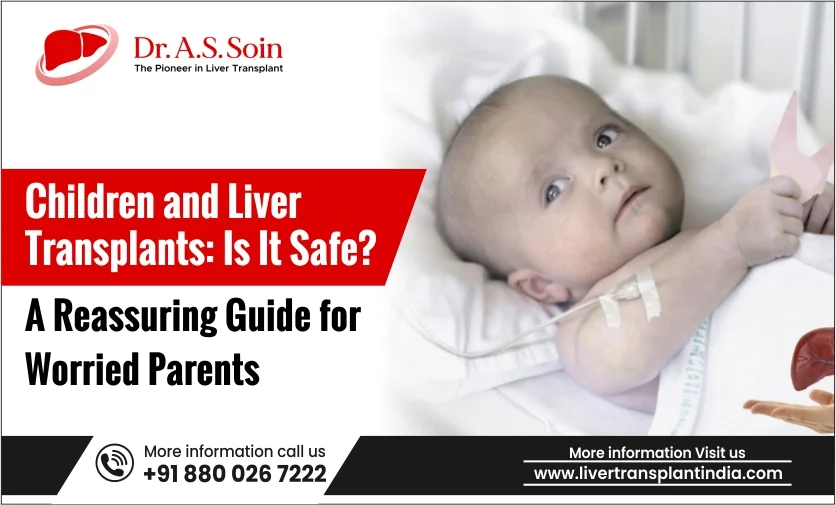
When your doctor first mentions the term “liver transplant” for your child, it can feel overwhelming. Questions arise instantly: Is it really necessary? Will my child survive? Is this safely done in India? These concerns are completely natural. The reassuring truth is that thousands of families—both in India and worldwide—have faced this situation and gone on to see their children recover and thrive.
The encouraging news is that paediatric liver transplantation has advanced remarkably over the past two decades. Today, it is a well-established, life-saving procedure with excellent outcomes when performed at experienced centres. This guide is designed to help you understand when a transplant is needed, how it works, and why India—especially Delhi NCR—has become a leading destination for paediatric liver care.
Why Would a Child Need a Liver Transplant?
The liver performs over 500 essential functions, including detoxification, bile production, protein synthesis, and regulation of blood clotting. When the liver fails due to disease or structural abnormalities, transplantation may become the only definitive treatment. Common conditions leading to paediatric liver transplantation include:- Biliary atresia: A congenital condition where bile ducts are absent or blocked; the most common indication in infants.
- Wilson’s disease: A genetic disorder causing toxic copper accumulation.
- Autoimmune hepatitis: Immune-mediated damage to liver cells.
- Progressive familial intrahepatic cholestasis (PFIC): A group of inherited disorders causing severe cholestasis.
- Acute liver failure: Sudden, severe liver dysfunction due to infections, metabolic disorders, or drug toxicity (e.g., paracetamol overdose).
- Metabolic liver diseases: Including tyrosinemia, glycogen storage disorders, and selected cases of Alagille syndrome.
Is Paediatric Liver Transplant Safe? What Do the Numbers Say?
This is the most important question for any parent. The answer, based on current global and Indian data, is yes—paediatric liver transplantation is safe and highly effective in experienced centres.- One-year patient survival: approximately 90–95% in high-volume centres.
- Long-term survival: many children live into adulthood with good quality of life.
- Graft survival continues to improve with advances in surgical technique and immunosuppression.
Understanding the Paediatric Liver Transplant Procedure
A liver transplant involves replacing the diseased liver with a healthy donor liver. In children, living donor liver transplantation (LDLT) is the most common approach in India. In LDLT:- A parent or close relative donates a portion of their liver (usually the left lateral segment).
- Both the donor’s and child’s liver regenerate to near-normal size within weeks to months.
- Comprehensive evaluation by a multidisciplinary team (paediatric hepatology, transplant surgery, anaesthesia, and critical care).
- Pre-transplant optimization, including nutrition, infection control, and detailed immunological work-up.
- Simultaneous donor and recipient surgeries by separate specialized teams.
- Post-operative care in a dedicated paediatric transplant ICU.
- Long-term follow-up focusing on immunosuppression, growth, development, and vaccination.
Why Choose Delhi NCR for Paediatric Liver Transplant?
Delhi NCR has emerged as a major hub for paediatric liver transplantation, attracting patients from across India and internationally. Key advantages include:- Availability of highly experienced paediatric transplant teams under one roof.
- Advanced infrastructure, including dedicated paediatric ICUs and transplant units.
- High procedural volumes, which are closely linked to better outcomes.
- Cost advantage compared to Western countries, often without compromise in quality.
- Strong support systems for outstation and international patients (logistics, accommodation, coordination).
What Parents Often Worry About — And the Facts
Will the transplanted liver last a lifetime? In many cases, yes. With modern care, grafts can function for decades. Some patients may require re-transplantation later in life, but this is not the norm. Will my child need lifelong medication? Yes. Lifelong immunosuppression is required to prevent rejection. However, regimens today are more tailored and safer, with careful monitoring to minimize side effects. Is the donor at risk? Living donor liver surgery is considered safe when performed at experienced centres. For paediatric recipients, the donated portion is smaller, which further reduces donor risk. Serious complications are uncommon, and donor liver regeneration is rapid, typically restoring function within weeks. Can my child live a normal life after transplant? Yes. Most children return to school, physical activity, and normal social life within months. Catch-up growth is common, and many children become indistinguishable from their peers over time.Dr. A.S. Soin and the Medanta Liver Institute
Dr. Arvinder Singh Soin, Founder and Chief of Hepatobiliary and Liver Transplant Surgery at Medanta – The Medicity, is a pioneer of liver transplantation in India. Since the late 1990s, his team has built one of the largest and most experienced transplant programs in the region. The institute performs a high volume of liver transplants annually, including a significant number of paediatric cases, with outcomes comparable to global benchmarks. The program emphasizes a multidisciplinary approach involving surgeons, paediatric hepatologists, intensivists, anaesthesiologists, nutritionists, and rehabilitation specialists.Taking the First Step: What Families Should Do
If a transplant is being considered:- Seek a detailed evaluation from a paediatric hepatologist or transplant centre.
- Organize all medical records: blood tests, imaging, biopsy reports, and treatment history.
- Consider early consultation with a transplant team (in-person or virtual).
- Discuss potential living donors within the family.
A Final Word to Worried Parents
Facing the possibility of a liver transplant for your child is never easy. However, modern medicine offers real hope. With experienced teams, advanced infrastructure, and timely care, paediatric liver transplantation today is not just life-saving—it is life-restoring. India now stands among the leading countries in this field, and many children go on to live full, healthy, and active lives after transplantation. For more information:- Pediatric Liver Transplantation
- Transplant Process
- Living Donor Liver Transplant
- Rare Liver Diseases
Written and medically reviewed by Dr. A. S. Soin — published .