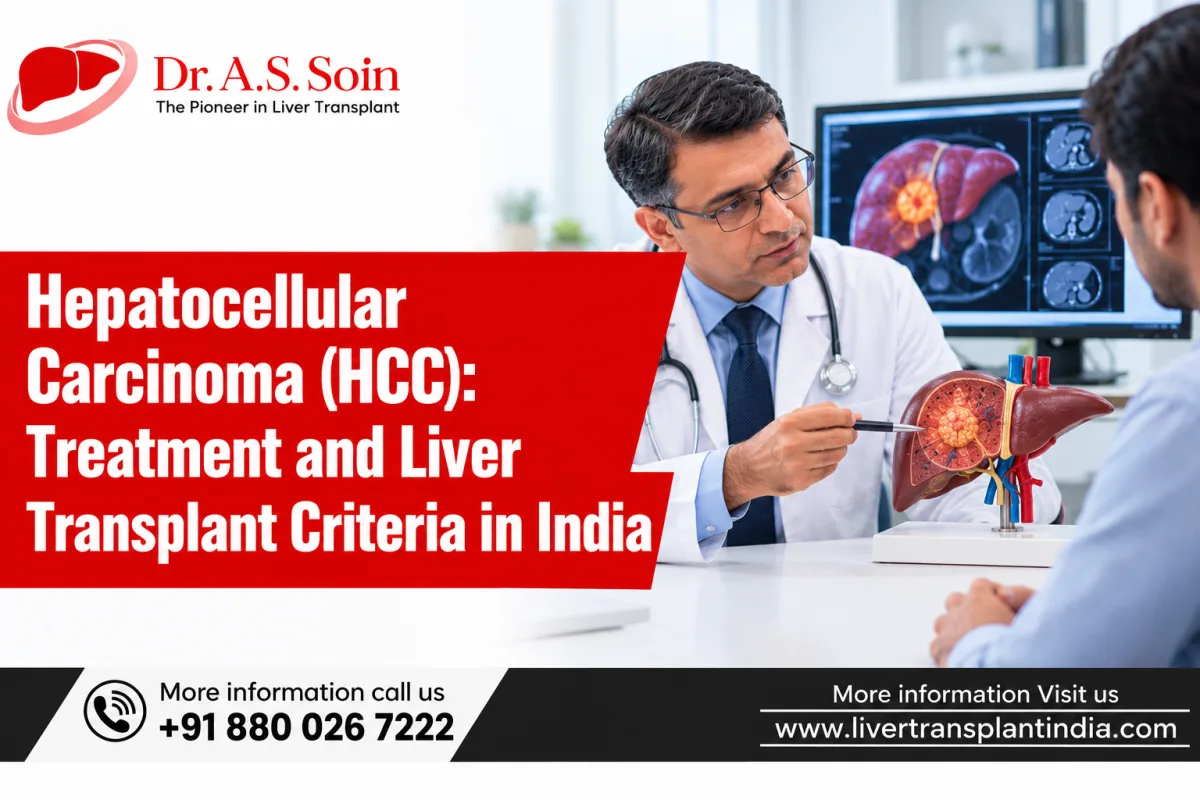
Hepatocellular carcinoma (HCC) is the most common primary liver cancer. Treatment depends on the tumour stage, the tumour's biology and how well the rest of the liver works. Options include surgery, ablation, TACE, TARE, immunotherapy and liver transplant. A transplant is considered when the cancer stays inside the liver and meets criteria such as Milan or UCSF.
A liver cancer diagnosis brings worry and a great deal of unfamiliar language. In this guide Dr Arvinder Soin, Chief Hepatobiliary and Liver Transplant Surgeon at Medanta – The Medicity, Gurugram, explains HCC in plain words: how it is found, how it is treated, and how transplant eligibility is judged in India.
Last updated: November 2026
Key facts at a glance
- What it is: cancer that begins in hepatocytes, the liver's main working cells.
- Who is at risk: people with cirrhosis, chronic hepatitis B or C, heavy alcohol use, or metabolic fatty liver disease.
- How it is found early: a liver ultrasound plus an alpha-fetoprotein (AFP) blood test every six months in high-risk patients.
- How it is staged: the Barcelona Clinic Liver Cancer (BCLC) system, alongside the Child-Pugh, MELD 3.0 and albumin-bilirubin (ALBI) scores.
- Main transplant rule: the Milan criteria — one tumour ≤5 cm, or up to three tumours each ≤3 cm.
- Reported outcome: about 70% to 80% five-year survival after a transplant within accepted criteria (Mazzaferro and colleagues, New England Journal of Medicine, 1996, and later published series). Results vary between patients.
What is hepatocellular carcinoma (HCC)?
HCC begins in hepatocytes, the liver's main functional cells. Unlike secondary (metastatic) liver cancer, it starts in the liver rather than spreading there from another organ. It usually develops after years of chronic liver inflammation, where repeated injury causes cirrhosis — widespread scarring that raises the risk of cells turning malignant.
Who is at higher risk of HCC?
Certain long-standing conditions and metabolic factors raise the risk:
- Metabolic dysfunction-associated steatotic liver disease (MASLD): once called non-alcoholic fatty liver disease, it is linked to obesity and type 2 diabetes and is the fastest-growing cause of HCC in India. See how fatty liver can progress to cirrhosis and transplant.
- Chronic hepatitis B infection: a major cause of HCC across India. The World Health Organization notes that chronic hepatitis B puts people at high risk of death from cirrhosis and liver cancer.
- Chronic hepatitis C infection: causes long-term inflammation and scarring if left untreated. Hepatitis B and C testing identifies both early.
- Heavy alcohol use: prolonged use leads to alcohol-related cirrhosis and a higher cancer risk.
- Cirrhosis from any cause: including autoimmune hepatitis and genetic disorders such as haemochromatosis (iron overload).
Patients with chronic hepatitis B or advanced MASLD can occasionally develop HCC without having cirrhosis first, which is why routine monitoring matters even when scarring has not been confirmed.
What are the symptoms of HCC?
Early HCC rarely causes anything noticeable. By the time symptoms appear, the disease is often more advanced. Watch for:
- Discomfort, pain or heaviness in the upper right abdomen
- Unexplained weight loss and loss of appetite
- Persistent tiredness or weakness
- Yellowing of the skin and eyes (jaundice)
- Abdominal swelling from fluid build-up (ascites)
- A sudden decline in someone whose cirrhosis had been stable
Why six-monthly screening matters
Because early HCC is silent, six-monthly screening is essential for high-risk people, especially those with cirrhosis or chronic hepatitis B. Standard surveillance is a liver ultrasound together with an alpha-fetoprotein (AFP) blood test every six months. Finding a tumour early widens the range of treatments that can still work.
Which tests confirm HCC?
- Multiphase computed tomography (CT) or magnetic resonance imaging (MRI): these track blood flow through liver nodules. Radiologists score them with the Liver Imaging Reporting and Data System (LI-RADS). Because HCC has a distinctive vascular pattern, a diagnosis in a cirrhotic liver is usually confirmed without a biopsy.
- Blood markers: alongside AFP, teams often test protein induced by vitamin K absence or antagonist-II (PIVKA-II), which can detect HCC even when AFP is normal. These sit alongside routine liver function tests.
- Liver biopsy: a needle sample is taken only when imaging is unclear, or when genetic profiling is needed before systemic therapy. The different types of liver biopsy are chosen to match the situation.
- Staging scans: a high-resolution chest CT and a fluorodeoxyglucose (FDG) or choline positron emission tomography (PET-CT) scan check whether the cancer has spread beyond the liver, and give a sense of how aggressive it is.
How do doctors choose the right treatment?
Treatment is chosen by weighing three things together: what the tumour looks like, how well the liver is working, and how fit the patient is. No single factor decides it. The team then places the patient in a stage and matches the stage to the treatments that are realistic for them.
- Tumour characteristics: the number and size of nodules, invasion of blood vessels, AFP and PIVKA-II levels, and spread outside the liver.
- Liver function: assessed with the Child-Pugh score, the MELD 3.0 score and the ALBI grade, which read blood tests alongside clinical signs such as ascites or confusion (encephalopathy).
- Patient fitness: overall strength, measured with the Eastern Cooperative Oncology Group (ECOG) performance status, and any other medical conditions.
These are combined using the Barcelona Clinic Liver Cancer (BCLC) staging system:
| Stage | Clinical profile | Treatments considered |
|---|---|---|
| Very early (0) and early (A) | A single tumour, or up to three nodules each ≤3 cm, with preserved liver function | Liver resection, liver transplant, or thermal ablation |
| Intermediate (B) | Several tumours confined to the liver, without major blood vessel invasion | TACE, TARE, systemic therapy, or a transplant after successful downstaging |
| Advanced (C) | Tumour invading major blood vessels, or spread outside the liver | First-line immunotherapy combinations or targeted therapy, sometimes with radiotherapy or TACE |
| End stage (D) | Severe, uncorrectable liver failure or significant frailty | Supportive and palliative care |
Every case is reviewed by a multidisciplinary tumour board of transplant surgeons, hepatologists, medical oncologists and interventional radiologists.
What are the treatment options for HCC?
Liver resection. Surgeons remove the section of liver holding the tumour, often laparoscopically or with robotic assistance. It suits a localised tumour when the remaining liver is healthy enough to regenerate, without severe cirrhosis or portal hypertension.
Liver transplantation. The whole diseased liver is removed and replaced with a healthy donor liver or part of one. It is the only treatment that addresses both the cancer and the underlying cirrhosis in a single operation.
Thermal ablation. Guided by ultrasound or CT, a probe is placed into the tumour and destroys the cancer cells with microwave (MWA) or radiofrequency (RFA) heat. It works well for tumours up to about 3 cm.
TACE (transarterial chemoembolisation). An interventional radiologist passes a catheter into the artery feeding the tumour and delivers concentrated chemotherapy with tiny blocking particles, starving the tumour of its blood supply.
TARE (transarterial radioembolisation). Microscopic beads carrying radiation (yttrium-90) are delivered into the tumour's blood vessels. TARE is increasingly used to control larger tumours or shrink them towards transplant eligibility.
Stereotactic body radiotherapy (SBRT). Tightly focused external radiation beams destroy liver tumours while sparing nearby tissue. It often serves as a bridge to transplant.
Systemic medicines. Immunotherapy and targeted therapy have changed advanced HCC care. First-line combinations such as atezolizumab with bevacizumab, or durvalumab with tremelimumab, prompt the immune system to attack cancer cells while restricting the tumour's blood vessel growth. Oral targeted drugs such as lenvatinib and sorafenib are also used. In selected patients, systemic therapy shrinks advanced tumours enough to allow surgery or a transplant.
Supportive care. For frail patients with end-stage liver failure, the focus moves to symptom relief, nutrition and quality of life.
Why consider a liver transplant for HCC?
A transplant offers the greatest likelihood of long-term disease-free survival, because it removes both the tumours that can be seen and microscopic pre-malignant changes, and replaces the cirrhotic liver that could generate new cancers later. Patients transplanted within established criteria have about 70% to 80% five-year survival, similar to patients transplanted for non-cancerous conditions (Mazzaferro and colleagues, New England Journal of Medicine, 1996, and later series). Results vary between patients.
A transplant is not appropriate if the cancer has spread outside the liver or has invaded the main portal vein trunk. The immunosuppressive medicines needed to prevent rejection can speed up relapse if tumour cells are still circulating in the body.
What are the liver transplant criteria for HCC?
Protocols balance size and number against tumour biology:
| Criteria | Tumour size and number permitted |
|---|---|
| Milan criteria | One tumour ≤5 cm, or up to three tumours each ≤3 cm |
| UCSF criteria | One tumour ≤6.5 cm, or up to three tumours (largest ≤4.5 cm, total diameter ≤8 cm) |
| Up-to-Seven criteria | Diameter of the largest tumour in cm, plus the total number of tumours, ≤7 |
| Metroticket 2.0 and AFP models | Combine tumour size and number with AFP blood levels to predict survival |
Across every protocol there must be no spread outside the liver and no visible invasion of major blood vessels. Our guide to which liver cancers may need a transplant sets out how these rules apply to other tumour types.
Looking beyond size: tumour biology
Size alone does not decide the outcome. Teams also judge how aggressively a tumour behaves:
- Marker trends: persistently high or rapidly rising AFP (above roughly 400 to 1,000 ng/mL) and PIVKA-II levels point to a higher risk of recurrence.
- PET-CT avidity: tumours that light up brightly on an FDG PET-CT scan tend to be poorly differentiated and more aggressive.
- Response to treatment: tumours that shrink or lose their blood supply after TACE, TARE or immunotherapy show more favourable biology.
What are bridging and downstaging therapy?
- Bridging therapy uses local treatments such as ablation, TACE or SBRT in patients who already meet transplant criteria, to stop the tumour progressing while they wait for surgery.
- Downstaging therapy uses TACE, TARE or systemic therapy to shrink tumours that start out beyond transplant limits. If they come back within accepted criteria and stay stable with falling AFP and PIVKA-II levels over an observation period of roughly three to six months, a transplant can go ahead.
How does liver transplant for HCC work in India?
Most liver transplants in India are living donor liver transplants (LDLT), where a healthy blood relative donates part of their liver, which regenerates in both donor and recipient within weeks. That shapes HCC care in three ways.
- Timely surgery. Deceased donor allocation is regulated under the Transplantation of Human Organs and Tissues Act and coordinated by the National Organ and Tissue Transplant Organisation (NOTTO) with its regional and state counterparts, where organs are scarce. LDLT allows surgery to be scheduled soon after evaluation and any downstaging, reducing the risk of the tumour progressing in the meantime.
- Wider selection, with biological safeguards. Because a living donor organ does not draw from the public deceased-donor pool, Indian centres following Indian National Association for the Study of the Liver (INASL) consensus guidance can consider carefully selected patients beyond the Milan and UCSF limits, provided the PET-CT is negative, AFP and PIVKA-II are controlled, and major blood vessels are clear.
- Donor safety first. Teams will not put a healthy donor through major surgery unless the recipient's expected five-year survival is favourable, generally above 60%. Donors go through independent medical, psychological and legal assessment before consenting.
What does the pre-transplant evaluation include?
- Triphasic liver CT or MRI, with AFP and PIVKA-II blood tests
- Whole-body PET-CT and high-resolution chest CT to rule out distant spread
- Full heart, lung and kidney assessment
- Multidisciplinary review by transplant surgeons, hepatologists and oncologists
- Detailed counselling for the family and the donor
What follow-up is needed after treatment?
Lifelong surveillance is essential. For transplant recipients, teams often tailor anti-rejection medicines, frequently combining mammalian target of rapamycin (mTOR) inhibitors such as everolimus or sirolimus with low-dose calcineurin inhibitors, which protect the new liver and carry some anti-cancer activity. Follow-up includes:
- Serial AFP and PIVKA-II tests alongside liver function panels
- Periodic multiphase abdominal and chest scans, especially in the first three years
- Continuing antiviral treatment for hepatitis B or C to prevent the virus reactivating
How can you lower your risk of HCC?
- Get vaccinated against hepatitis B. It is part of India's universal childhood immunisation programme and is available to unvaccinated adults.
- Test for and treat viral hepatitis. Oral antivirals suppress hepatitis B, and the World Health Organization reports that direct-acting antivirals clear the infection in more than 95% of people with hepatitis C.
- Look after metabolic health. Controlling diabetes, weight and cholesterol through diet and exercise helps prevent MASLD progressing.
- Avoid alcohol, particularly with underlying fatty liver or viral hepatitis.
- Keep to six-monthly surveillance. High-risk patients should not skip scheduled ultrasounds and blood tests.
Conclusion
HCC develops mostly in livers already affected by chronic hepatitis, alcohol or metabolic fatty liver disease. Treatments now run from minimally invasive ablation and radioembolisation through to immunotherapy and transplantation. Combining size-based rules such as Milan and UCSF with marker trends and PET-CT findings lets India's living donor programmes offer individualised treatment while keeping donor safety first. If you or someone in your family has been diagnosed with HCC, speak to a multidisciplinary liver team early, so every option is still open. You can arrange an appointment to discuss your reports.
Sources
- World Health Organization. Hepatitis B fact sheet, 2026.
- World Health Organization. Hepatitis C fact sheet, 2026.
- National Cancer Institute. Liver Cancer Treatment (PDQ), 2025.
- National Organ and Tissue Transplant Organisation (NOTTO), Government of India. notto.mohfw.gov.in.
- Mazzaferro V and colleagues. Liver transplantation for the treatment of small hepatocellular carcinomas in patients with cirrhosis. New England Journal of Medicine, 1996.
This article is for information only and is not medical advice. Treatment decisions and outcomes differ from patient to patient. Please consult a qualified liver specialist about your own condition.
Written and medically reviewed by Dr. A. S. Soin — published .