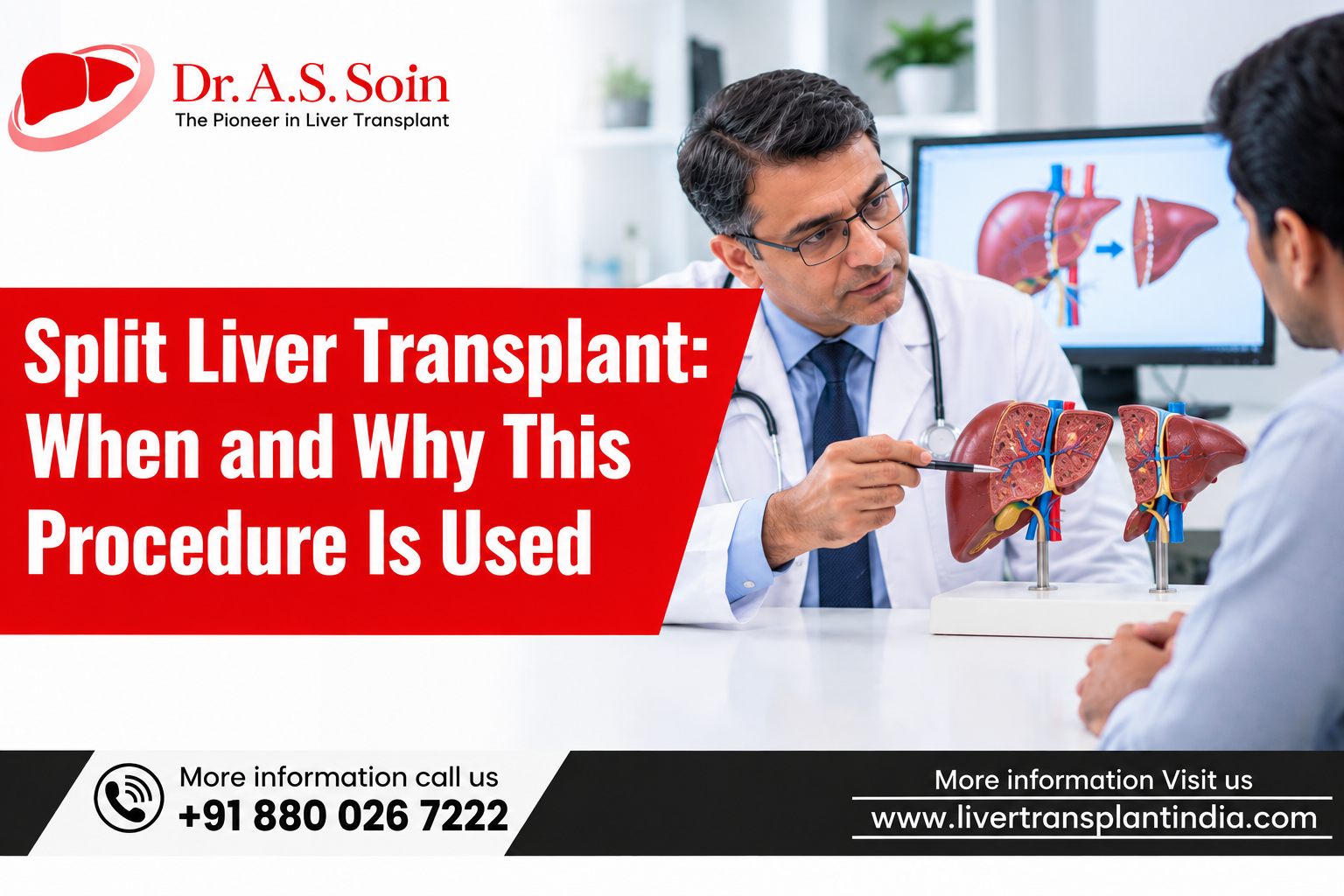
A split liver transplant is an advanced surgical procedure that allows a single donated liver to save two lives. Typically, surgeons allocate the smaller left portion to a child and the larger right portion to an adult. This technique helps bridge the gap in donated organs, giving more patients timely access to a life-saving transplant.
Families preparing for this procedure naturally have questions: Can a partial liver function properly? Is the surgery safe? What do long-term outcomes look like? Understanding how the procedure works can help patients and their families feel confident and prepared when speaking with their transplant team.
In this guide, Dr. Arvinder Soin, Chief Hepatobiliary and Liver Transplant Surgeon at Medanta – The Medicity, Gurugram, explains the procedure in clear, accessible terms. We cover how surgeons divide a donor liver, who qualifies for the surgery, modern preservation techniques, potential risks, and the recovery journey.
What is a split liver transplant?
A split liver transplant involves dividing one healthy liver from a deceased donor into two functional sections for two separate recipients. This is possible because of the liver’s remarkable anatomy. The organ is divided into eight independent functional segments, each possessing its own blood inflow, blood outflow, and bile drainage pathways (bile is a digestive fluid produced by the liver to break down fats). These natural anatomical planes allow surgeons to divide the organ cleanly while preserving the vital blood supply and biliary drainage each half needs to thrive.
The organ comes from a deceased donor—typically someone declared brain-dead whose family has consented to organ donation. Unlike living donor liver transplantation, this approach does not require a healthy family member to undergo major surgery. Instead, each portion of the donated organ is matched to a waiting recipient based on medical urgency, body weight, and anatomical compatibility.
How is the liver divided?
Surgeons use two primary splitting techniques depending on the medical needs and sizes of the recipients:
| Type of split | Portions created | Typical recipients |
|---|---|---|
| Conventional split (adult and child) | A smaller left lateral section (segments 2 and 3) and a larger extended right section (segments 1 and 4–8). | The smaller left section goes to a child; the larger right section goes to an adult. |
| Full left–right split (two adults) | A full left lobe (segments 1–4) and a full right lobe (segments 5–8). | The left lobe goes to a smaller adult or teenager; the right lobe goes to a moderately sized adult. |
The adult-and-child split is the most widely practised approach. The smaller left lateral section makes up roughly 20–25% of the liver's total volume, which is ideal for a pediatric recipient, leaving 75–80% for an adult. Dividing a liver between two adults is more technically demanding because both portions must be large enough to support adult metabolic needs. Specialists carefully calculate the graft-to-recipient weight ratio (GRWR), vascular anatomy, and the severity of the recipients' liver disease before proceeding.
Where and how is the liver split?
Surgeons can divide the donor liver using three main methods, including recent advances in organ preservation:
- In situ split: Surgeons divide the liver inside the donor’s body during organ retrieval while blood is still circulating. This minimises cold storage time, helps surgeons control bleeding along the cut surface immediately, and yields excellent graft quality.
- Ex situ (bench) split: The whole liver is removed first, cooled in a specialised preservation solution, and divided on a sterile back table at the transplant centre.
- Machine perfusion-assisted split: In modern transplant centres, surgeons increasingly split the liver while it is connected to an oxygenated machine perfusion device (hypothermic or normothermic machine perfusion). This recent innovation keeps the liver oxygenated and reduces preservation injury, improving outcomes for both recipients.
Why is a split liver transplant used?
The primary driver behind split liver transplantation is the severe global shortage of donor organs. Splitting a single optimal organ maximises the impact of one family's generous donation.
- Saves two lives from one donation: A single deceased donor liver provides two patients with a second chance at life, expanding the donor pool without lowering surgical standards.
- Provides size-matched organs for children: Children with end-stage liver disease need a graft that fits their smaller abdominal cavity. Pediatric deceased donors are rare, and whole adult livers are too large. Split liver transplantation gives children a properly sized graft while ensuring the remaining right portion helps an adult.
- Reduces waiting list mortality: By increasing the number of available grafts, split transplantation shortens waiting times. This is especially critical for infants and young children, whose health can deteriorate rapidly while waiting.
- Offers an alternative when no living donor is available: While living donor transplantation is common in India, not every patient has a relative who is medically eligible or able to donate. Split liver transplantation offers a vital pathway to surgery without putting a healthy living donor at risk.
When is a split liver transplant considered?
Not every donated liver can be safely divided, and not every patient is an ideal candidate for a partial graft. Transplant teams evaluate three essential pillars: donor quality, recipient suitability, and hospital logistics.
1. The donor liver must be in optimal condition
Because splitting a liver is technically delicate, the donor organ must be resilient and healthy. Specialists look for:
- Younger donor age: Typically under 40–50 years, as younger livers regenerate faster and have healthier blood vessels.
- Brief ICU stay: A short hospital stay before donation reduces the risk of infection or organ stress.
- Normal liver function: Blood tests must show healthy liver enzyme and bilirubin levels.
- Minimal liver fat (steatosis): Little to no fat accumulation ensures the divided portions function immediately after surgery.
- Stable circulation: The donor should have stable blood pressure without requiring high doses of support medications.
2. The recipients must be carefully matched
For both children and adults, size matching is critical. Surgeons ensure the transplanted portion makes up at least 0.8% to 1% of the recipient’s body weight (GRWR). In addition, because a partial graft has a slightly smaller functional reserve right after surgery, adult recipients are carefully selected based on their overall medical stability.
3. Advanced surgical coordination
Splitting a liver requires specialised microsurgical expertise and seamless coordination. Often, two surgical teams operate simultaneously to minimise the time the liver parts spend outside the body (ischemia time).
How does it compare to other liver transplants?
| Feature | Whole liver transplant | Split liver transplant | Living donor transplant |
|---|---|---|---|
| Organ source | Deceased donor | Deceased donor | Healthy living donor (usually a relative) |
| Portion transplanted | Entire liver | One portion of the liver | One portion of the liver |
| Patients helped | One | Two | One |
| Risk to a healthy donor | None | None | Surgical risks for the living donor |
| Scheduling | Emergency (when an organ is allocated) | Emergency (when a suitable organ is allocated) | Planned and scheduled in advance |
| Primary considerations | Longer waiting list times | Technical complexity; risk of bile leaks from the cut surface | Donor safety and recovery |
Is part of a liver enough?
For properly matched patients, a partial liver is sufficient because the human liver has the unique ability to regenerate. Within days of the transplant, the partial graft begins creating new liver cells. Over the next few weeks to a few months, it grows to reach the volume required for the adult recipient's body. In children, the transplanted section grows naturally alongside the child into adulthood.
However, the graft must be large enough to handle the body's immediate metabolic demands before regeneration finishes. If a graft is undersized, the patient can develop small-for-size syndrome, leading to prolonged jaundice, fluid buildup in the abdomen (ascites), and delayed recovery. Modern 3D volumetric imaging and strict recipient matching allow transplant teams to largely prevent this issue.
What are the risks and clinical outcomes?
Like any major surgery, split liver transplantation carries potential risks, which are actively managed by specialised transplant care teams.
General transplant risks:
- Organ rejection: The immune system may recognise the new liver as foreign. Daily immunosuppressant medications effectively prevent or treat this.
- Infection: Anti-rejection medicines lower immunity, making patients more susceptible to infections early on.
- Postoperative bleeding: Bleeding can occur during or shortly after surgery and occasionally requires intervention.
- Medication side effects: Long-term anti-rejection therapy requires monitoring for blood pressure, blood sugar, and kidney health.
Risks specific to a split liver:
- Bile leakage or narrowing (strictures): Because the liver tissue is divided, bile can occasionally leak from the cut edge, or scar tissue can narrow the bile duct. Most biliary issues are managed effectively with drains or endoscopic stents.
- Vascular complications: The divided blood vessels are smaller, carrying a slightly higher risk of narrowing or clotting (thrombosis). Surgeons use high-magnification microsurgery and blood thinners to protect blood flow.
- Small-for-size syndrome: Rare when graft-to-recipient weight ratios are carefully calculated beforehand.
What does current medical literature show?
Recent international studies and registry data show that at high-volume, experienced centres, patient and graft survival rates for split liver transplants are comparable to whole liver transplants—and have significantly reduced pediatric waiting list deaths. While partial grafts historically carried a slightly higher rate of bile duct and vascular adjustments, advances in surgical splitting techniques and machine perfusion have narrowed this gap considerably.
Recovery and daily life after surgery
Recovery follows a structured pathway similar to other liver transplant procedures:
- In the hospital: Patients spend the first few days in a specialised transplant ICU for close monitoring, followed by 1 to 2 weeks in a dedicated transplant ward.
- The first few months: Outpatient visits and blood tests are frequent to monitor liver regeneration, check bile flow, and fine-tune medication doses.
- Long-term care: Most recipients take lifelong immunosuppressant medications. Once stable, patients return to work, school, and active daily routines with periodic check-ups.
Healthy habits for long-term success:
- Take immunosuppressant medications at the exact same time every day.
- Attend all scheduled blood tests and clinic visits.
- Practise strict hand hygiene and food safety, especially during the first six months.
- Consult your transplant coordinator before starting any new prescription, over-the-counter drug, or herbal supplement.
- For children, work with the pediatric team to manage growth milestones, catch-up vaccinations, and a smooth return to school.
Warning signs to report immediately: Contact your transplant team right away if you notice a fever or chills, yellowing of the skin or eyes (jaundice), dark tea-coloured urine, pale stools, abdominal pain or swelling, or unusual drowsiness.
Split liver transplantation in India
In India, living donor liver transplantation currently accounts for the majority of procedures, while deceased organ donation continues to grow steadily across several states. Under the Transplantation of Human Organs and Tissues Act (THOTA), deceased donor allocation is coordinated transparently through the National Organ and Tissue Transplant Organization (NOTTO), along with regional (ROTTO) and state (SOTTO) networks.
Splitting suitable deceased donor livers is an increasingly vital strategy in India to maximise scarce organs, particularly for infants and children who lack a compatible living donor in their family. Pledging to be an organ donor and sharing that decision with your family remains one of the most impactful ways to help ease the national organ shortage.
Questions to ask your transplant team
Preparing questions for your doctor can help your family make calm, informed decisions:
- Why is a split liver transplant recommended for me or my child?
- How do you ensure the liver portion is the right size for the body's needs?
- What are our specific risks compared to waiting for a whole liver or pursuing a living donor?
- What is our backup plan if a suitable split graft does not become available in time?
- What does the typical hospital stay and post-discharge support look like at this centre?
Split liver transplantation represents a major surgical advance that turns a single organ donation into a life-saving gift for two people. When performed at an experienced transplant centre with careful donor and recipient matching, it offers safe, durable outcomes that rival whole-organ transplantation.
This article is for general information and does not replace medical advice. Treatment decisions, medication doses and follow-up schedules differ for every patient, and outcomes vary between patients. Please discuss your own case with your transplant team.
Written and medically reviewed by Dr. A. S. Soin — published .